In 1996 I cut the plastic off a CD I'd bought at HMV, pressed play, and got 63 minutes of pure, uninterrupted pleasure. Endtroducing..... was made almost entirely from other people's records. Thirty years on I wanted to stand in the room those records came from. So I asked Claude to build it.
01The idea
This is the fifth side project built by describing it. Sample Explorer was a tool, the Listening Room was a place, ALL CAPS was a room full of secrets and Baker's Dozen was an instrument.
DJ Shadow called his method collage: the snare from one record, the kick from another, part of a bassline from a third, and then the hard part, making it tell a story. In 2015 I wrote a track-by-track breakdown of the samples, The Inspirational Endtroducing, and he shared it with his fans. This project is that article turned into a place.
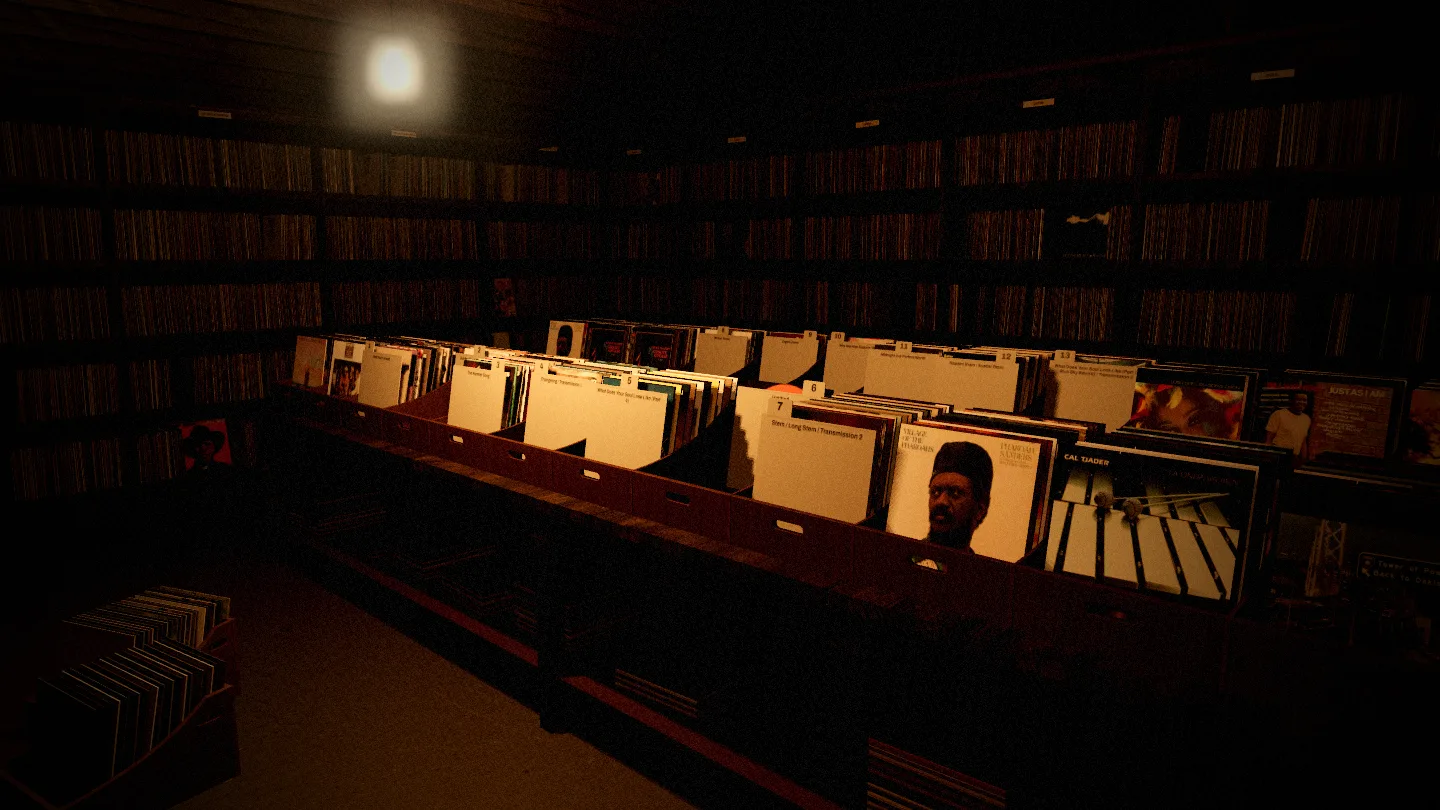
The Basement is a record shop basement at night. Thirteen crates, one per track, each holding the records Shadow sampled to make it. You dig, pull a record out and hear it. Then you press Build this track and watch the song come together from its sources, one at a time.
02The brief
I gave Claude my 2015 article and the four earlier projects to start from. It came back with research and a few directions. The one we chose was a basement, because the album is about digging as much as about sampling, and because the cover is two people in the racks of a record shop.
03Check first
Same rule as every project: before designing anything, find out whether the thing you need exists. Here that meant: can you actually hear the records?
Claude went through all of WhoSampled's entries for the album and looked for a 30-second preview of each source on Deezer and Apple. The bar was two in three. It came back at 69%. Good enough to go, with a plan for the rest: the silent records would stay in the crates anyway, because they're still on the album, and in a real shop not every record plays.
Later I pushed on that:
Are we able to really try and fill all the samples on records, can we use YouTube as an additional channel?
It used the YouTube playlists I'd made for the 2015 article as the first source, then searched for the rest. Now 94 of the 98 records can be heard. The last four aren't anywhere online.
04What got built
What happens when you open it:
- Come down. The first screen is the album cover and three lines on what to do. One button. It also starts Midnight in a Perfect World, playing low.
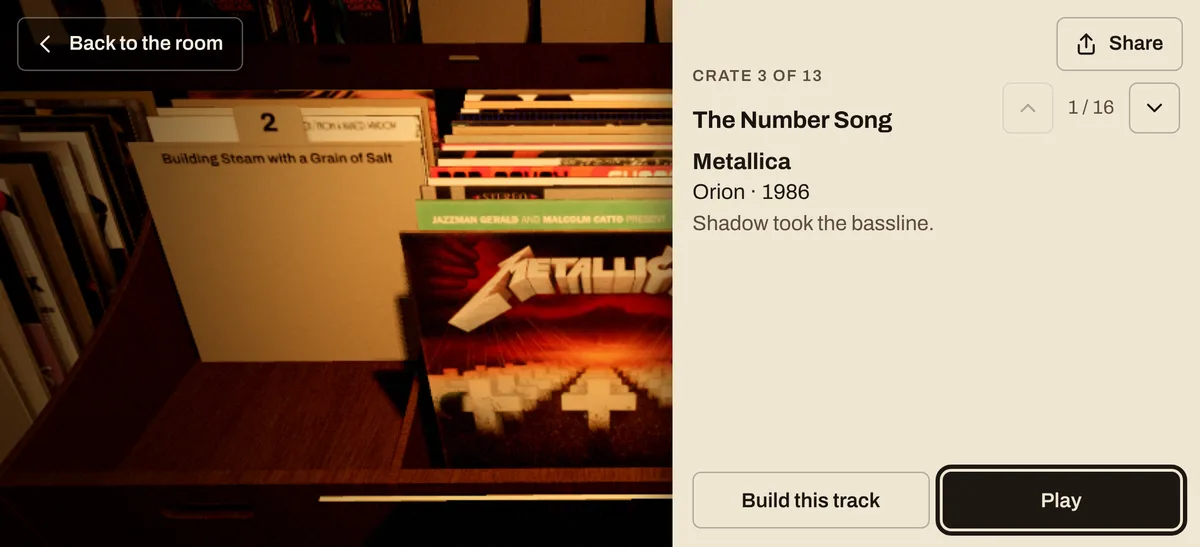
- Dig. Pick a crate on the benches. Drag to look round the room, and pinch to get closer to the far crates. Flip through with the wheel, a swipe or the arrow keys. Pull a record out and its preview plays.
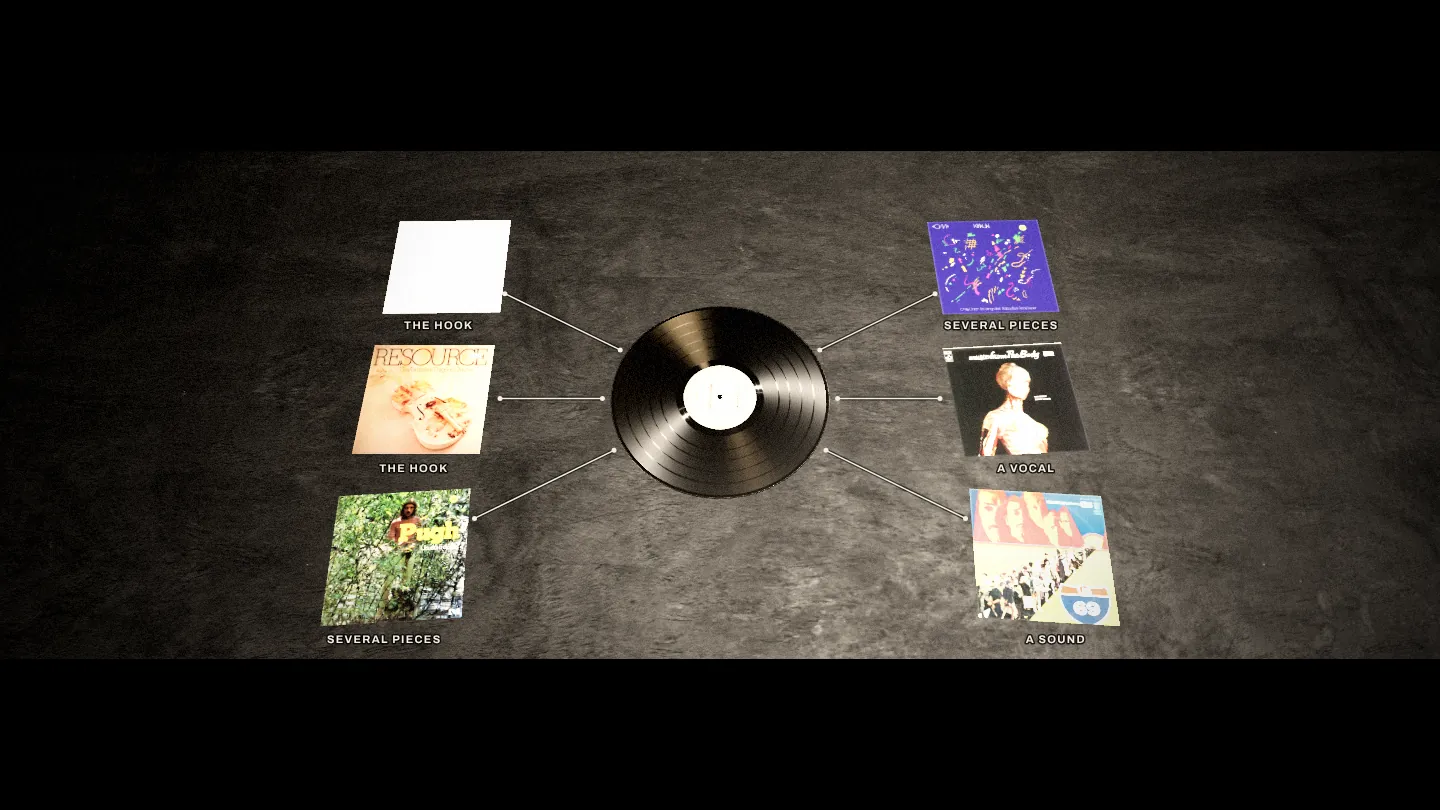
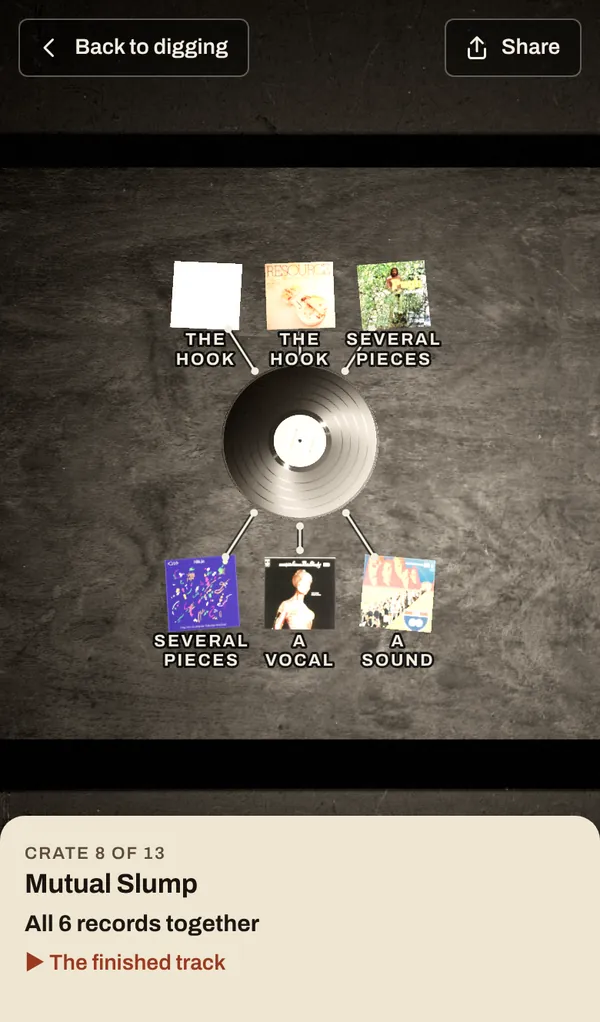
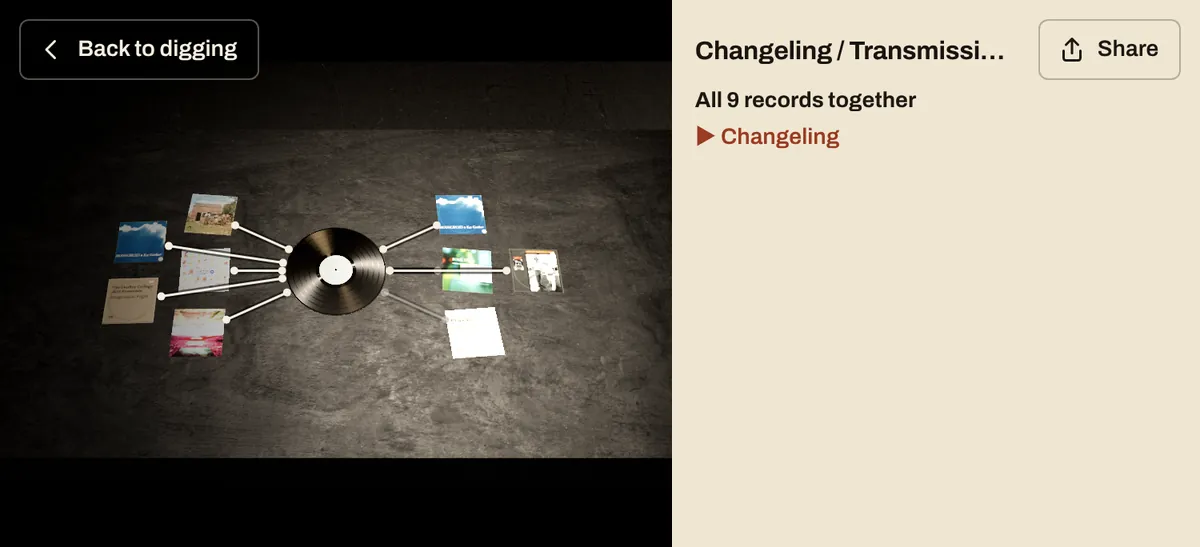
- Build. The bulb flickers out and the room develops like a print, in black and white, in the wide format of the camera the cover was shot on. Each source drops onto a table with a line to the finished record and what Shadow took from it: the drums, the bassline, a vocal. You hear each record from the moment he sampled it, then the moment it turns up in his track. Then the whole track plays.
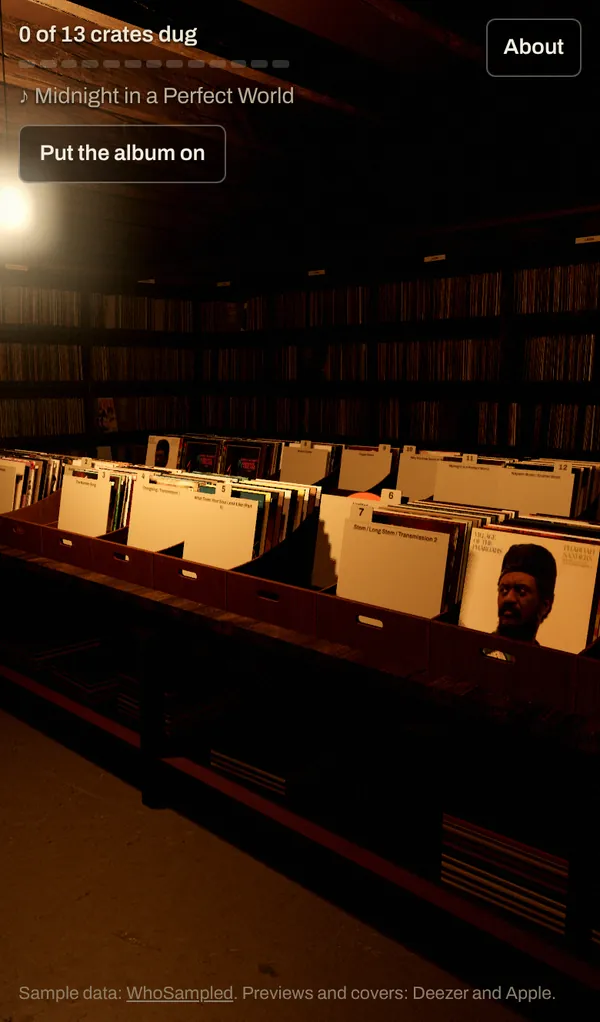
- Put the album on. The turntable plays the whole album through, one track at a time.
- Share. Every crate and every build has its own link, with its own preview image.
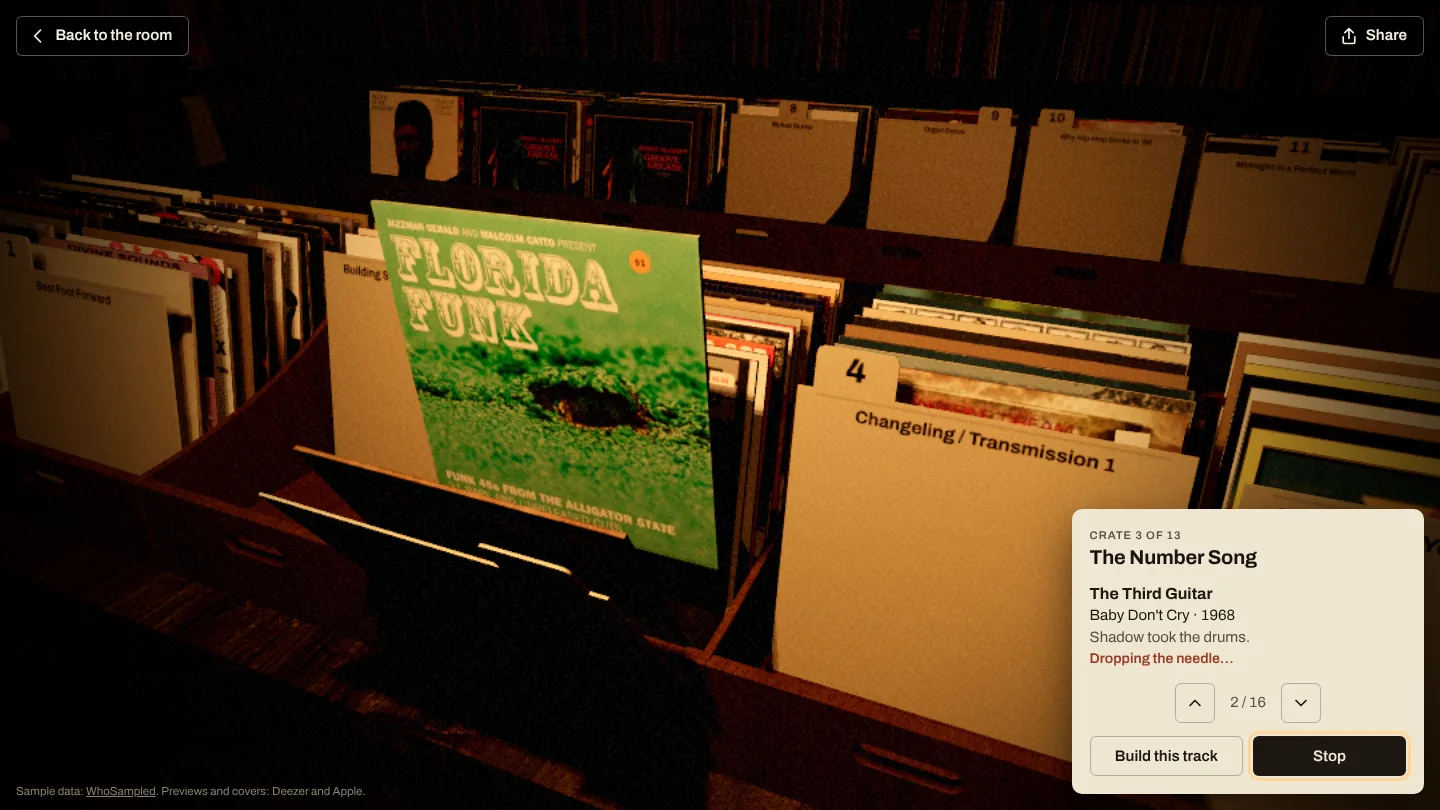 Dig
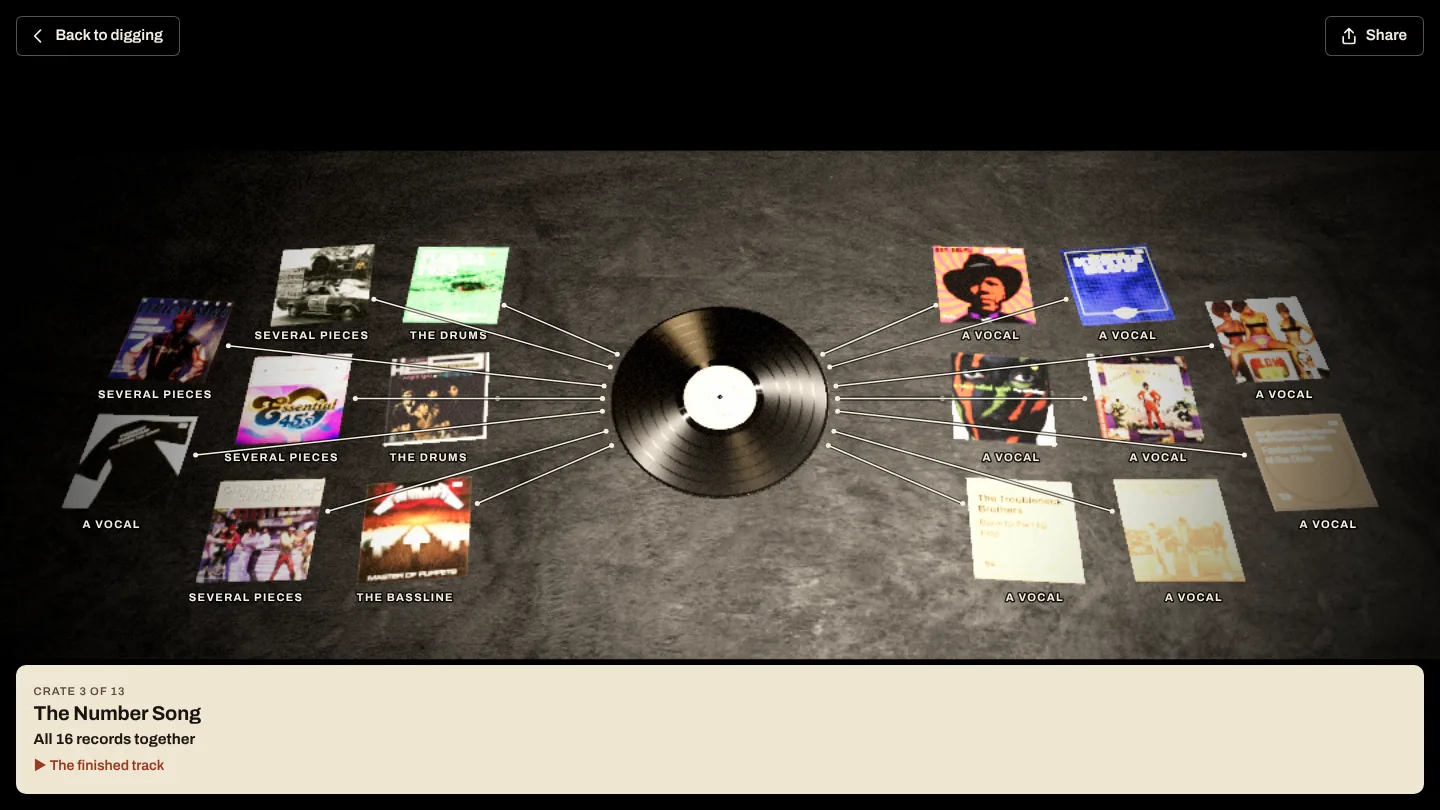 Build
05The look
Claude made three lighting tests of the same basement. I picked two: a single tungsten bulb for digging, and a black-and-white panorama for building, like the 6×17 camera the cover was shot on. Going from one to the other is the main transition: the bulb dies, and the photograph develops.
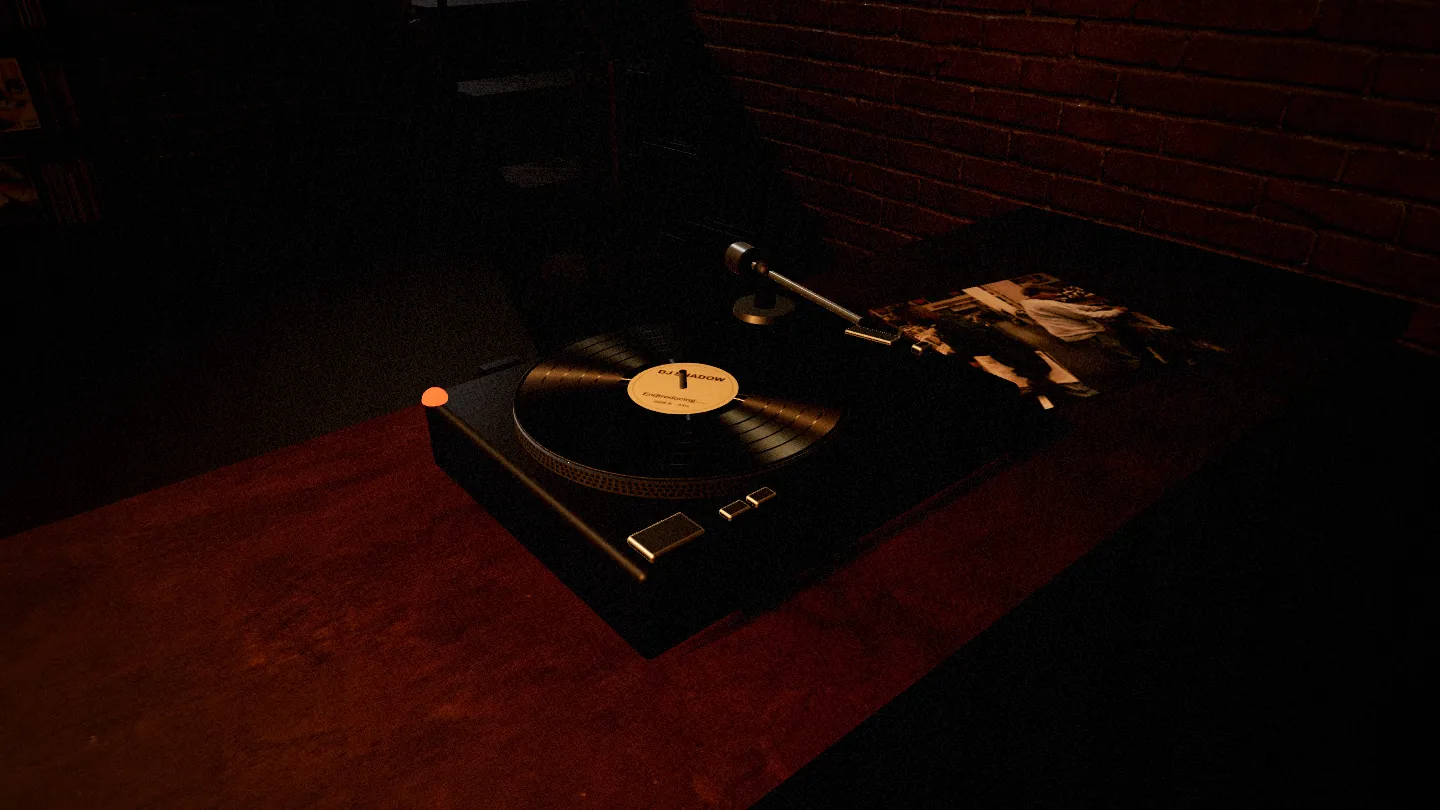 Bulb
 Panorama
Early versions used a handwritten marker font for labels and dividers. I didn't like it:
remove the … font… clean and modern
Everything has been set in Archivo since.
06Asking for realism
Most of the second day was me looking at screenshots and asking for it to be more real. These are the prompts that made the biggest difference, in order:
i want the rack to be joined, so each of the bins are together like in the album cover
this will be more realistic, for a record digger
The crates became long bins on the benches, divided into compartments, with filler stock packed either side.
Covers on records need to be hi res
i also wonder if the rest of the records in the rack should have covers too, it would raise the realism level considerably
Every filler record now has a real cover from the era, from 36 classic jazz, funk and soul albums. The spines on the walls are real records too, with names printed down them.
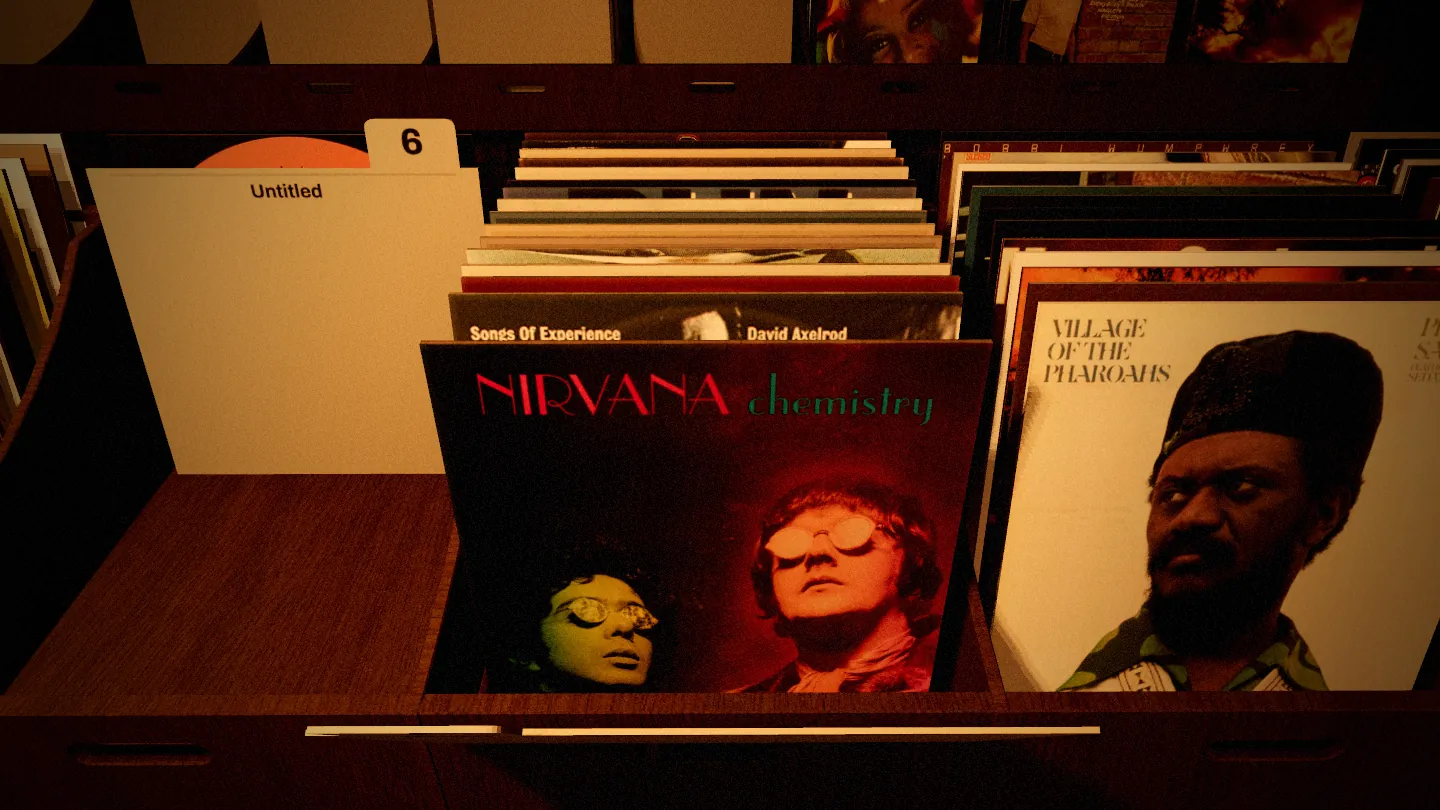
I think we can improve the render of these records
i think the actual record can be a lot better too, it's flat with no grooves
The finished track went from a black disc to a pressed record with grooves, gaps between tracks and a highlight that runs round them.
this would be better off if the covers were in colour
The build view had been turning the whole picture black and white. Now only the room does, and the covers keep their colour.
The biggest jump was covers on the rest of the records. Like every other fix here, it looked better the moment it stopped being a placeholder.
07How it works
The short version. Skip it if you came for the prompting.
- The site: three.js in the browser. The room is built in code, with textures from Poly Haven.
- The previews: fetched fresh each time you play one, because Deezer's links expire after 15 minutes.
- YouTube: records with no preview play in YouTube's own player, visible in the card, as YouTube's rules require.
- The sample times: from WhoSampled's sample pages, read by hand in a browser, because the site blocks scripts.
- Sharing: each track and build has a static page, so a shared link shows the right title and image.
08How I prompted
The overnight brief I left for the room rebuild was the most useful message of the project:
a highly detailed render of the room, records, smooth animations… Do not cut corners. Do not over-complicate the UX and do not add flair… Mo' Modals, Mo' Problems.
It set the rule for everything after: quality, not features. When Claude suggested a TV playing film clips, a CD on the stairs and a sampler box, they got parked as flair.
Short screenshot prompts did most of the work after that. A picture and five words, like:
back always make more sense top left of the screen
this is overly complex, simplify it, and build a proper system for cards, buttons and position of the card
Fix the layout, make the cover wider, it's overall terrible
09What broke
- The button that didn't work. "Come down" did nothing on the live site. An invisible loading message was sitting on top of it and taking the click. The automated tests had clicked the button directly, which skips whatever's covering it. Now every test uses a real mouse click.
- Previews that disappeared. Seven Deezer previews had been withdrawn since the first check, including Giorgio Moroder's "Tears". Six now play from Apple, one from YouTube, and every record has a YouTube fallback.
- "Shared with you: crate '66". The start screen told everyone they'd been sent a crate that doesn't exist. A matching bug. Fixed, and the line now only shows on real shared links.
- Stuck in low resolution. On my phone everything looked soft and grainy. To keep things smooth, the room drops its resolution when frames run slow and takes it back when there's headroom. It only took it back above 77 frames a second, which a 60 Hz phone never reaches, and Low Power Mode's 30 sent it straight to the bottom. Now it only drops below 25, and phones render sharper than before.
- The video that wouldn't start. On an iPhone, YouTube's player sat still. iOS won't let a page start a video with sound: the tap has to land on the video itself. So the first video now says "Tap the video to play", and the ones after it start on their own.
- "Tap the video to play" on a laptop. The phone prompt turned up on desktop whenever YouTube was slow to start, though a click is never needed there. It's phones only now.
10On a phone
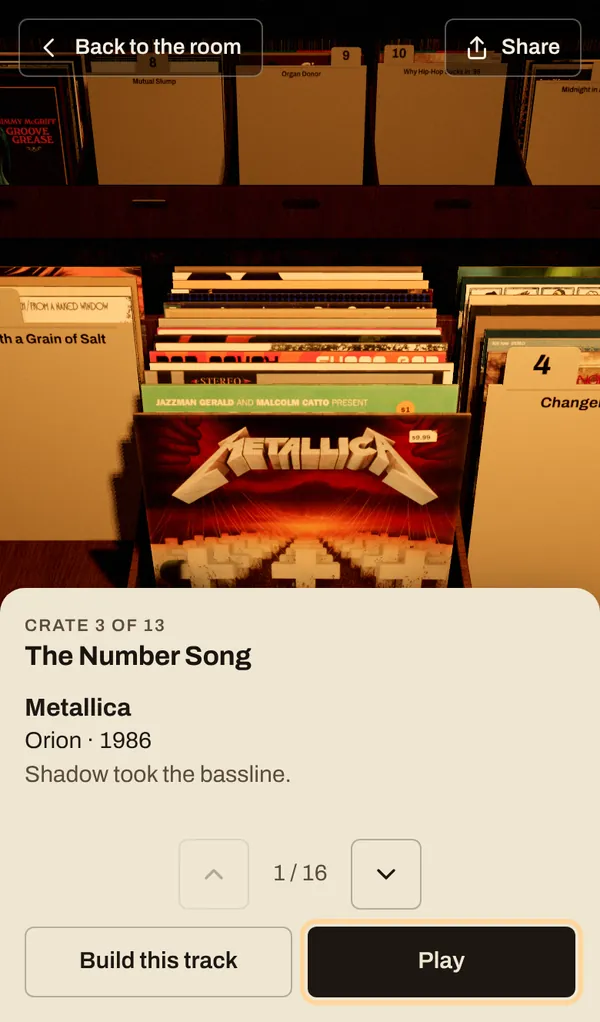
On a phone held upright, the card becomes a sheet along the bottom and the build view lays the records out in rows above and below the finished track. On its side, every screen splits in two: the cover beside the words on the way in, an open crate beside its card, which runs the full height, and in a build, the records on the left with the track, the video and the buttons down the right.
 Room
 Crate
 Build
 Crate
 Build
Testing it on my own phone turned up the last round of fixes:
On portrait it's impossible to get to crate 1
Need to be able to move / pan in the room too
Crate 1 was the far end of the bench, under the buttons. Now you can drag to look round the room and pinch to zoom.
I think we can improve the quality of everything on mobile too, it's low res and grainy
This would be better as a split screen view
Phones also got a lighter start. They load half-size cover sheets and surface maps first, and the full covers arrive once you're in the room: 4.4 MB before you can come down, down from 11.4.
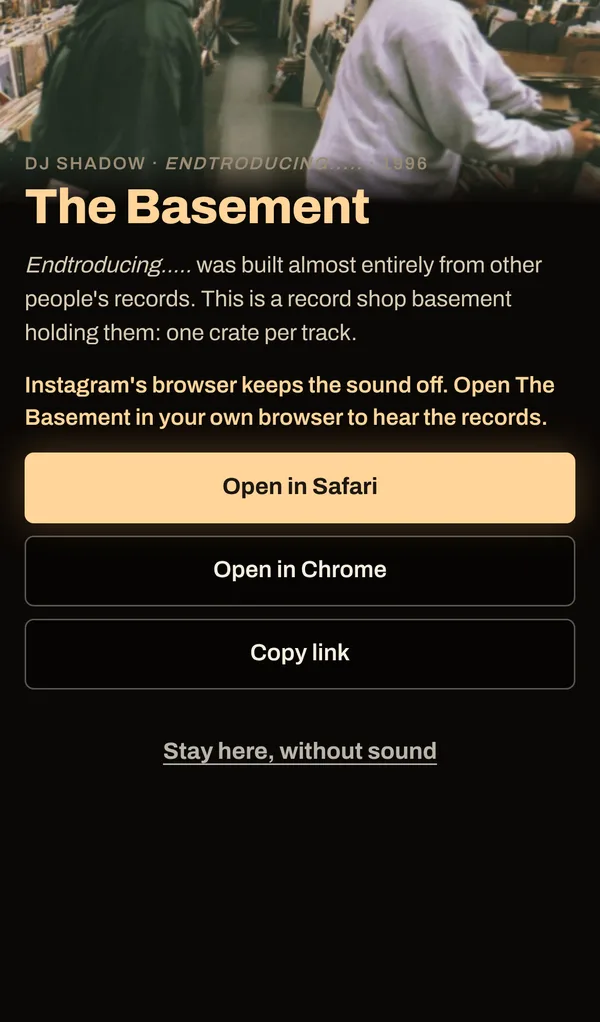
Then there's Instagram. A link in a story opens in Instagram's own browser, which keeps the sound off, and a basement of records with no sound isn't much use. So when the page finds itself inside Instagram, Facebook or TikTok, the start screen says so and offers a way out: Open in Safari, Open in Chrome, or Copy link. You can still stay without sound.
11What I took from it
Check first, then fill the gaps. 69% was enough to start. YouTube took it to 96%.
Real beats made. Real covers, real spines, a real record with grooves. Each looked better the moment it stopped being a placeholder.
Test on the real thing. The emulator said the phone version was fine. My phone said otherwise.
Screenshots are the brief. A picture and a sentence beat a paragraph.
Quality, not flair. "Mo' Modals, Mo' Problems" kept it simple.
Click it like a person. A test that clicks from code can pass while the real button is broken.
Read it in a real browser. WhoSampled blocks scripts, so the sample times came from my own Chrome.
Go and dig. Open crate 3, pull out the Metallica, then build The Number Song.
A fan tribute to DJ Shadow's Endtroducing..... (Mo' Wax, 1996). Not affiliated with DJ Shadow, Mo' Wax or the shop on the cover. Sample data from WhoSampled. Previews from Deezer and Apple, and videos from YouTube, streamed, not hosted. Textures from Poly Haven (CC0). DJ Shadow photo by Scott Sandars (CC BY 2.0). Built with Claude Code.